

Board Performance · 2025
In this section14 topics
- Prevention of Conflicts of Interest3 items
- Prevention of the Use of Inside Information3 items
- Anti-Corruption4 items
- Whistleblowing3 items
- Selection of Directors & Chief Executives4 items
- Selection of Independent Directors2 items
- Director Development1 item
- Evaluation of Board & Subcommittee Performance3 items
- Subcommittees1 item
- Meeting Attendance & Remuneration2 items
- Supervision of Subsidiaries & Associated Companies4 items
- Board Duty Performance — Overview1 item
- Audit Committee Duty Performance1 item
- Executive Committee Duty Performance1 item
Prevention of Conflicts of Interest
Has the Company Acted to Prevent Conflicts of Interest?
Yes
Operations in the Past Year
The Company shall strictly comply with the laws issued by the SET and the SEC on potential conflicts of interest and give priority to eliminating said conflicts of interest among stakeholders by enforcing inter-company regulations that are prudent, just and transparent. Information regarding potential conflicts of interest will be made comprehensive, clear and in a timely fashion for the benefit of the Company. Furthermore, the Company will also have a policy to supervise the use of internal information and impose sanctions on executives or employees who disclose internal company information to the public or utilize such information for personal benefit. The internal structure of shares that are held within a company, including shares held by Directors and Executives will be fully disclosed in the Company's annual report as well.
Number of Conflict-of-Interest Cases
| Metric | Current Year | Previous Year | Two Years Ago |
|---|---|---|---|
| Total number of cases or issues related to conflicts of interest (cases) | 0 | 0 | 0 |
Prevention of the Use of Inside Information
Has the Company Acted to Prevent the Use of Inside Information?
Yes
Operations in the Past Year
The Board of Directors has recognised the importance of preventing the Company’s internal information against use for personal benefits, and therefore made a policy to keep confidential information that have not been made available to the public. Such confidential information shall only be disclosed to the parties concerned.
The Company has advised directors, executives and auditors of their duties to report on the Company’s stocks held by them as well as the related persons having the following relationship in accordance with the such persons: (1) spouse or cohabiting couple (2) minor child (3) juristic person wherein directors, executives and the persons in (1) and (2) hold shares at an aggregate amount exceeding thirty percent of the total voting shares of such juristic person and to report changes to the Securities and Exchange Commission in section 59 and the penalty in section 275 according to the Act on Securities and Securities Exchange B.E. 2535. Moreover, the Company prohibits directors, executives and auditors including their such related persons from purchasing, selling, transferring, or taking transfer of the Company’s stock using internal information not yet disclosed to the public, and from trading of stocks particularly during 1 month and to notify the Company Secretary (appointed by Board of Directors) at least one day before trading the securities before disclosure of financial statements to the public. In the cases where directors, executives and auditor including their such related persons purchase, sell, transfer, or taking transfer of the Company’s stocks do not fall under the above categories, all such transactions shall be reported to the Securities Exchange Commission and the Stock Exchange of Thailand within three (3) working days of their occurrence. There are reports for the Company’s stocks held by directors and executives at the quarterly Board of Directors Meeting.
As for employees, the Company includes this subject as a matter of ethics to be observed by employees. Employees must not use their positions, duties and the Company’s confidential information to seek benefits for themselves and related parties.
In 2025, the Company did not find any reports of directors, executives, employees, or staff of the Company trading in securities by using inside information, and there was no trading in securities during the period of 1 month prior to the disclosure of the financial statements to the public.
If any of the above persons are found to use the Company’s internal information for their own benefits, the Company shall deem that such persons have committed a serious disciplinary offense and will be subjected to penalisation pursuant to the Company’s Articles of Association.
Number of Inside-Information Cases
| Metric | Current Year | Previous Year | Two Years Ago |
|---|---|---|---|
| Total number of cases or issues related to the use of inside information to seek benefits (cases) | 0 | 0 | 0 |
Anti-Corruption
Has the Company Acted on Anti-Corruption?
Yes
Operations in the Past Year
Procurement must be conducted in accordance with established rules or procedures, ensuring fairness and transparency throughout the process. Consideration should be given to the reasonableness of price, quality, and after-sales service, as well as the standards that the vendor or service provider must meet. Additionally, officials must not engage in any activities or business transactions that could result in personal gain through their position in procurement, whether directly or indirectly, and must not use information obtained through procurement for personal or others' benefit.
Personnel must not engage in corruption or any actions that may lead to corruption in the procurement process of government agencies, whether directly or indirectly.
Directors, executives, employees, and individuals related to the Company are strictly prohibited from providing, requesting, offering, promising to offer bribes, including money, assets, or other benefits, or attempting to influence others to engage in any activities, whether directly or indirectly, that could result in an unfair advantage or other benefits in the procurement process, or contract performance, either before or during the bidding process, or after entering into the procurement contract, or to protect any inappropriate interests according to business ethics.
Directors, executives, employees, and stakeholders associated with the Company are prohibited from soliciting or engaging in corrupt practices for the benefit of the Company, themselves, or their families.
The Company has a strict policy of not paying facilitation fees in any form, whether directly or indirectly, and will not engage in or accept any actions in exchange for facilitating business operations.
Personnel must strictly adhere to the Company’s Anti-Fraud and Corruption Prevention Policy.
Personnel must not ignore or disregard any transactions, actions, or behaviors that may be suspected of being related to corruption. Such personnel must report the issue to the Company and cooperate in investigating the facts.
Personnel must avoid any actions that present a conflict of interest. If any action or circumstance arises that may be seen as a conflict of interest with the Company, the personnel are required to report the conflict through the designated channels.
Employees must comply with the Company’s Information Security Requirement Guidelines to prevent any corruption or fraud that may arise through online channels.
Form of Anti-Corruption Operations
| Operation |
|---|
| Review of appropriateness in anti-corruption |
| The participation in anti-corruption projects |
| Communication and training for employees on anti-corruption policy and guidelines |
| Assessment and identification of corruption risk |
| The monitoring of the evaluation of compliance with the anti- corruption policy |
Number of Corruption Cases
| Metric | Current Year | Previous Year | Two Years Ago |
|---|---|---|---|
| Total number of cases or issues related to corruption (cases) | 0 | 0 | 0 |
Whistleblowing
Has the Company Implemented Whistleblowing Procedures?
Yes
Operations in the Past Year
The Company has established a policy for whistleblowing or reporting any misconduct or complaint, to ensure that supervisors and relevant departments are fulfilling their roles in overseeing, advising and monitoring the conduct of personnel to ensure compliance. Individuals can report any suspicious actions that may directly or indirectly cause fraud or corruption within the Company. The Company has mechanisms in place to protect whistleblowers as well as keeping every report confidential. Reports of misconduct or complaints can be made through the designated channels as follows:
Written letters to be sent to:
Mr. Anant Tangtatswas (Independent Director and Chairman of the Audit Committee)
Business Online Public Company Limited
1023 MS Siam Tower, 32ndFloor, Rama 3 Road
Chong Nonsri, Yannawa, Bangkok 10120
Emails to be sent to: BOLwhistleblowing@bol.co.th
The complainant must specify details of the potential misconduct or complaint, together with the whistleblower’s contact details for the Company’s further proceedings.
The reported information from both channels will be directed to the Chairman of the Audit Committee.
The whistleblower will be protected, and the information will be kept confidential, with no impact on their job position during the investigation and after the process is completed.
Number of Whistleblowing Cases
| Metric | Current Year | Previous Year | Two Years Ago |
|---|---|---|---|
| Total number of cases or issues received through whistleblowing channels (cases) | 0 | 0 | 0 |
Selection of Directors & Chief Executives
Are Directors Selected Through the Nomination Committee?
Yes
Are Chief Executives Selected Through the Nomination Committee?
Yes
Rights of Minority Shareholders on Director Appointment
The Company gives shareholders the right to propose any matters to the agenda and the right to nominate a person to be elected as the Company’s Director prior to the meeting for the 2025 Annual General Meeting of Shareholders. During December 1, 2024 – December 31, 2024, no agenda or nominated persons were proposed during the specified period in this regard.
The shareholders of the Company received both Thai and English invitation to the Annual General Meeting of Shareholders at least 21 days in advance. The invitation details include date, time, and place of meeting, matters to be decided at the meeting with their cause and background, details of each agenda and Board opinion together with the attached Proxy Form A, the Proxy Form B, and the Proxy Form C as required by law, including the list of Independent Directors and the guidance for appointment of proxy as well as the meeting location map. Simultaneously, the invitation was published through the Company's website at https://www.bol.co.th at least 30 days prior to the meeting, whereas advertisement for the 2024 Annual General Meeting of Shareholders was also published in the newspaper 3 consecutive days prior to the meeting.
Method of Director Appointment
| Method |
|---|
| Method whereby each director requires approval votes more than half of the votes of attending shareholders with voting rights |
Selection of Independent Directors
Criteria for Selecting Independent Directors
Qualifications and Selection Process of Independent Directors
The selection process for independent directors is conducted by the Nomination and Remuneration Committee according to the established criteria and procedures. The independent directors must possess qualifications, experience, knowledge, and specialized skills that are beneficial to the Company. They should also be able to provide independent opinions and meet all the requirements set by the relevant regulations.
Did Any Independent Director Have a Business or Professional Relationship?
No
Director Development
Qualifications for Director Selection
| Qualification | Skill & Expertise |
|---|---|
| The Nomination and Remuneration Committee regularly reviews the Board composition using the Board Skill Matrix as a key reference tool to ensure alignment with the Company’s diversity objectives and strategic priorities. To ensure a comprehensive board composition and effective functioning, the Company has developed a Board Skill Matrix to guide the assessment of each director's overall skills. This matrix also serves as a basis for future director recruitment, ensuring the directors are at an appropriate level to support business growth. The Board Skill Matrix assessment reveals that the board possesses diverse skills and experience across areas essential to the Company's business, including corporate governance, risk, accounting, finance, information technology, law, sustainability, and relevant industry experience. This enables the board to effectively and appropriately determine direction, strategies, and oversee the Company's operations. | 140 · Description: Information & Communication Technology · 141 · Description: Law · 143 · Description: Accounting · 144 · Description: Finance · 147 · Description: Sustainability |
Evaluation of Board & Subcommittee Performance
Criteria for Evaluating Board Performance
The Board of directors is committed to managing the Company in accordance with Good Corporate Governance principles. To fulfil such commitment, the policies, performance mechanisms and regulations are established in order to ensure operating efficiency and achieve the Company’s objectives on business practices that promote transparency and accountability to all stakeholders. The Good Corporate Governance policy contains 5 categories, with “Responsibilities of the Board” (item 5) mentioning the evaluation of the Board of Directors’ performance through a Board Self-Assessment, as outlined below.
The evaluation on the performance of the Board of Directors, both individually and collectively in group, is the director’s responsibility. The results will be reviewed together to enhance and develop the Board of Directors’ operations.
To evaluate the annual performance of the Board of Director, the following evaluation will be conducted:
Individual Director Evaluation Form
Board Evaluation Form
Individual Sub - Committee Evaluation Form
CEO Evaluation Form
Evaluation of Board Performance in the Past Year
The Board conducts an annual Board Self-Assessment to evaluate performance of the Committees and Chief Executive Officer. The evaluation form contains the following assessment criteria: structure, qualification, role and responsibility, meeting attendance, Board performance, relationship with the Management, self-development, and training for individual Director. The completed assessment forms are compiled to draw conclusion and recommendation to be used to improve work for the greatest benefit in business operation.
In 2025, the Board of Directors has evaluated the performance of the Board according to the Board Evaluation Form. The evaluation results are largely divided into 2 levels:
3 = Mostly agree or there has been progressive implementation of the matter
4 = Strongly agree or there has been complete implementation of the matter
The result to percentage by each category, these are as followed:
1. Structure and characteristics of the Board
2. Roles and responsibilities of the Board
3. Board meetings
4. The dynamics of the Board’s duty performance
5. Relationship with management
6. Self-development of directors and executive development
The overall rating of the 2025 Board assessment result was excellent or scored 99.37%.
For Individual Directors, the evaluation results are largely divided into 2 levels:
3 = Mostly agree or there has been progressive implementation of the matter
4 = Strongly agree or there has been complete implementation of the matter
The result to percentage by each category, these are as followed:
1. Personal Qualities
2. Readiness for duty
3. The participation at the Meeting
4. Roles and responsibilities
5. Relationship with the Board and management
The overall rating of the 2025 Individual Director assessment result was excellent or scored 99.22%.
Sub-Committees Performance Evaluation
Each member of the Sub-Committee has evaluated the performance according to the Sub Committee Evaluation Form. Therefore, the evaluation results are largely divided into 2 levels:
3 = Mostly agree or there has been progressive implementation of the matter
4 = Strongly agree or there has been complete implementation of the matter
The result to percentage by each category, these are as followed:
1. Structure and characteristics of the Sub Committee
2. Sub Committee meetings
3. Roles and responsibilities of the Sub Committee
4. Board Reporting of the Sub Committee
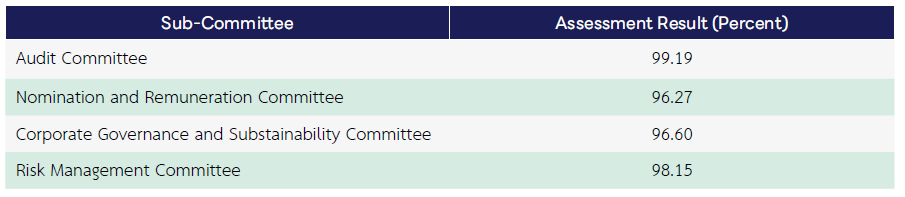
The overall rating of the 2025 Sub-Committee assessment results were excellent as summarized below:
CEO Performance Evaluation
The Company has conducted a performance evaluation for the Chief Executive Officer (CEO). The evaluation criteria are categorized into 3 main areas: operation progress, performance evaluation, and CEO development. Various relevant factors are considered, including:
Leadership
Strategy determination
Strategy execution
Financial planning and operations
Relationship with the Board
External relationships
Management and personnel relations
Succession
Products and service knowledge
Personal characteristics
Evaluation Process
The evaluation is conducted systematically and presented to the Board of Directors during a meeting prior to the assessment. The assessment is then carried out, and the outcomes are utilized for the continuous development.
Evaluation Results
The performance evaluation of the Chief Executive Officer (CEO) for the year 2025 showed an overall rating of excellent, with a score of 99.69%.
Additionally, the results are reported to the Board of Directors annually for the review of the performance of the directors and the CEO. The review process includes gathering feedback on various issues related to their duties during the past year, allowing for improvements and enhanced work efficiency. The self-assessment forms for the directors and the CEO are created according to the scope of authority and responsibilities outlined in the charters of each sub-committee, following the good practices of the Stock Exchange of Thailand, and adjusted to suit the Company's structure and business nature.
Evaluation Results
| Evaluated Body | Group — Carried Out? | Group — Grade / Average Score | Group — Grade / Full Score | Individual (Self-Assessment) — Carried Out? | Individual (Self-Assessment) — Grade / Average Score | Individual (Self-Assessment) — Grade / Full Score | Cross (Assessing Other Directors) — Carried Out? |
|---|---|---|---|---|---|---|---|
| Board Of Director | Y | 99.37 | 100 | Y | 99.22 | 100 | N |
| Audit Committee | Y | 99.19 | 100 | N | N | ||
| Other Subcommittee | Y | 96.6 | 100 | N | N | ||
| Other Subcommittee | Y | 98.15 | 100 | N | N | ||
| Executive Committee | N | N | N | ||||
| Other Subcommittee | Y | 96.27 | 100 | N | N |
Subcommittees
Subcommittees
| Results of the Subcommittee's Duty Performance |
|---|
In 2025 the Committee called three meetings. The meeting was well participated with due care by all the members of the Committee. The Committee's members proactively participated, contributed and gave recommendation beneficial for improvement of the Domination and Remuneration of Directors of the Company. The Committee constantly reported the meeting results including comments and recommendations to the Board of Directors for consideration. The committee called the meeting to consider the proposed agenda with due care, transparency and independence for the best interest of the Company and it's shareholders, within the given powers and responsibility prescribed therein the committee's charter, which is in accordance with SET's regulations and guidelines according to good governance. The major topics considered are:
As at December 31, 2025 there are 10 directors in the Company's Board of Directors, of which, 4 of the 10 directors are executives, 6 are non-executives, 4 are independent directors (more than 1/3 of the board members). In 2025 the directors received remuneration according to the directors remuneration table. The Remuneration Committee has performed the duties assigned to him with care, prudence, transparency in order to create fairness and maximum benefit to the Company and shareholders as a whole. |
During the year 2025, the Risk Management Committee convened a total of two (2) meetings. The Committee placed importance on establishing an effective enterprise risk management process and jointly considered the following key matters:
In this regard, the Risk Management Committee has carried out its responsibilities to promote an effective risk management process that supports the achievement of the Company’s goals, vision, and mission in a stable and sustainable manner. The Committee remains committed to continuously enhancing risk governance in line with good governance practices and to addressing future challenges on an ongoing basis. |
In 2025, the Corporate Governance and Sustainability Committee convened two meetings. The Committee carried out the duties assigned by the Board of Directors as stipulated in the Corporate Governance and Sustainability Committee Charter, with responsibilities for overseeing the company’s operations in accordance with good corporate governance principles. This includes ensuring transparent, accountable, and fair management that is open to scrutiny, treats all stakeholders equitably, and supports sustainable growth. The Corporate Governance and Sustainability Committee is responsible for establishing policy frameworks and development guidelines on corporate governance and sustainability, in order to strengthen the Company’s governance structure and systems. This involves promoting best practices alongside responsible business conduct with regard to social and environmental impacts. The Committee also provides consultation, advice, and recommendations beneficial to the Board of Directors and management in advancing the Company’s corporate governance and sustainability initiatives. The Corporate Governance and Sustainability Committee has continuously reported the meeting results and opinions to the Board of Directors. The performance of 2025 is summarized as follows:
The Corporate Governance and Sustainability Committee is confident that adherence to good corporate governance principles, conducting business based on ethical standards, and driving the organization with a sustainability-focused approach one that considers the Company’s role in the nation’s economic, social, and environmental dimensions are key elements that will enable the Company to advance toward becoming a leading organization capable of achieving long-term, stable growth while strengthening the confidence of shareholders and investors. For the Company’s operations in 2025, the Company received awards and ratings for compliance with good Corporate Governance principles and sustainability, as follows:
The performance results and previous evaluations reflect that the Company has firmly upheld the principles of good corporate governance. The Corporate Governance and Sustainability Committee is confident that driving the business with transparency and continuously enhancing the governance system will foster long-term growth and strengthen the trust of shareholders and all stakeholder groups. As a registered legal entity, the Company will continue to refine its corporate governance practices to align with the nature of its operations and continuously elevate them to meet international standards. |
Meeting Attendance & Remuneration
Types of Remuneration of the Board of Directors
The Nomination and Remuneration Committee has considered the duties of the Board of Directors and the responsibilities including each members’ respective roles, the amount of remuneration in relation to their responsibilities, the type and size of business, the commercial market and the Company’s competitors to ensure the remuneration is within an appropriate range to retain the quality of directors that are necessary for the Company’s operations. The type remuneration is provided as a monthly retainer, meeting allowance, as well as other benefits.
Remuneration or Benefits Payable to the Board
| Metric | Amount (Baht) |
|---|---|
| Remunerations or benefits pending payment to the board of directors over the past year (baht) | 0 |
Supervision of Subsidiaries & Associated Companies
Does the Company Have Subsidiaries or Associated Companies?
Yes
Is There a Mechanism for Overseeing Subsidiaries and Associated Companies?
Yes
Mechanism for Overseeing Management of Subsidiaries
The Board attaches great importance to the establishment of operational supervisory mechanism to be able to control, supervise and be responsible for the operations of the subsidiaries and associated companies in order to maintain the benefit from the Company’s investment. In this regard, qualified persons will be considered as the Company representative to serve as Director, Executive or authorized representative in subsidiaries or associated companies according to its shareholding proportion. The person appointed as the Director in the subsidiaries or associated companies has a duty to act for the best interests of such subsidiaries or associated companies.
In case of subsidiaries, the Company has established the concise, sufficient, and appropriate internal control system as well as other mechanisms for supervising such subsidiaries, for example, mechanisms for information disclosure in financial position, operating results, transactions between subsidiaries and the connected person as well as acquisition and disposition of assets or other important transactions. Supervision of accounting data retention and accounting records of subsidiaries must be able to be checked and prepared for the consolidated financial statements in a timely manner.
Oversight Mechanisms
| Mechanism |
|---|
| Sending representatives to act as directors, executives or controlling persons in proportion to shareholdings |
| Defining the scope of powers, duties and responsibilities of directors and executives who represent the company in setting important policies |
| Disclosure of financial information and operating results |
| Transactions between the Company and related persons |
| Other important transactions |
| Acquisition or disposal of assets |
| Internal control system of the subsidiary operating the core business is appropriate and sufficient in the subsidiary operating the core business |
Board Duty Performance — Overview
Board Duty Performance — Overall Description
TheBoard of Directors shall hold an annual general shareholders' meeting within four months after the last day of each fiscal year.
The Company had arranged Board of Directors meetings at least 1 time per 3 months and also arranged non-executive director meeting at least 1 time per a year. Therefore, in 2025, the Company had arranged non-executive director 1 time on 16thDecember 2025.
The Board of Directors shall prepare the statement of financial position and statement of comprehensive income as at the last date of the fiscal year for reporting to the shareholders in Annual General Meeting for their consideration and approval.
As deem appropriate, the Board of Directors may designate any director(s) or any person as their proxy to act on behalf of the Board on specific issues for a period of time under the Board supervision. The Board may change, amend or cancel the proxy whenever it deems appropriate.
The Board has approved Level of Authorization for delegation of authority at various levels, with clear approval framework and process. Some key areas are:
For Investments for management of finances, including the acquisition and disposition of government bonds, promissory notes, funds, forward contracts, etcver THB 20 million must be submitted to the Board for approval.
For Loan, Fund from financial institution, applying for, renewing, or extending credit facilities, including corporate credit cards, promissory notes, and other types of financing sources with financial institutions over THB 20 million must be submitted to the Board for approval.
For Investment, purchase, sale or joint venture, and disposal of some or all investments over THB 35 million must be submitted to the Board for approval.
Audit Committee Duty Performance
Results of the Audit Committee's Duty Performance in the Past Year
In 2025, there were 4 Audit Committee meetings, with all members attending each meeting. The Audit Committee informed the Board of Directors of the result of the work conducted by the Audit Committee during the respective Board of Director meeting. The annual year-end performance assessment of the Audit Committee as a whole and self-assessment were conducted, and the results were satisfactory. The areas under assessment were namely the structure, qualifications, the roles and responsibilities, the performance of duties and meetings. The key activities of the Audit Committee could be summarized as follows:
Review of Financial statements
The Audit Committee reviewed the quarterly, annual, and consolidated financial statements with the auditors by inviting executives in accounting and finance attended the meeting on the financial statement consideration agenda to clarify and answer questions from the Audit Committee regarding the completeness of the financial statements. Adjustment of important accounting items that affect the financial statements sufficiency of information disclosed in the financial statements and auditor's remarks the Audit Committee is of the opinion that the Company's financial statements. The items were presented correctly as they should be in accordance with financial reporting standards.
The Audit Committee held a meeting with the external auditors without the Management present so as to freely discuss the acquisition and review of material information involved in the preparation of the financial statements, the disclosure of information in accordance with relevant financial reporting standards for the benefits of the financial statements’ users, and Key Audit Matters, as well as to see whether there was any suspicious information indicating potential fraud according to Section 89/25 of the Securities and Exchange Act B.E. 1992, as amended by the Securities and Exchange Act (No.4) B.E. 2008. In 2025, the external auditors made no remarks and did not find any indications of suspicious incidents. Thus, the preparation of the financial statements and consolidated financial statements was conducted with reliability, transparency, and compliance with the Financial Reporting Standards, and the external auditors performed their duties independently and with verifiability
Review of Connected Transaction r the list of potential conflict of interest
The Audit Committee reviewed of Connected Transaction or the list of potential conflict of interests between the Company and its subsidiaries based on the arm’s length transaction principle ensuring the benefits of stakeholders, the sufficiency of the disclosure in accordance with the SEC’s rules and regulations.
The Audit Committee has reviewed the
The Audit Committee has reviewed the internal control system to ensure the effectiveness and efficiency of operations. There is reliability of financial and non-financial reporting both in terms of operation use of resources property custody prevent or reduce mistakes to achieve compliance with relevant laws and regulations. In addition, there is a continuous and systematic monitoring and evaluation. which did not find any significant problems or defects. The results of internal control assessment according to "Good Practices of the Stock Exchange of Thailand", the Company has a sufficient and appropriate control system. and is consistently followed. If, during the performance of its duties, the Committee finds or suspects any of the following situations which may have a material impact on the Company's financial condition or operating results, it must report these to the Board for rectification within a period of time the Committee deems appropriate:
A transaction which causes a conflict of interest;
Any act of fraud, irregularity, or material deficiency in an internal control system;
An infringement of the law on securities and exchange, the regulations of the SET, or any law relating to the Company's business.
Review of Law and regulations
The Audit Committee reviewed the business conducted in compliance with the law and regulations. The Committee also closely monitored the Company’s preparation for legal implementation before the actual enforcement of new legislation.
Review of Good Governance
The Audit Committee audited the Company to ensure good governance for transparency and confidence of shareholders. The Committee emphasized the Board’s commitment and communicated this to the Company’s management and employees.
In 2025, there were no reports submitted through the whistleblowing system, which enables external parties and employees to report any misconduct arising from non-compliance with applicable laws, corporate regulations, the Anti-Corruption Policy, or the Company’s Corporate Governance Manual.
Internal Audit
The Committee regularly reviewed Internal Audit’s charter, taking into consideration the unit’s independence and efficiency of execution while also reviewing the annual internal audit plans, which embraced key risks and supported BOL’s strategies. It also monitored the execution of Internal Audit’s plans quarterly and reviewed examination findings and risk management report, in the process providing recommendations and tracking corrective actions to promote good governance and develop internal control efficiency. The Committee reviewed and endorsed Internal Audit’s restructuring and manpower improvement for greater adequacy and suitability. Finally, it advocated continual internal auditors’ competency development and reviewed the annual performance of the Head of Internal Audit department.
Appointment of the Company’s auditor and review of the Audit Fee for 2025
The Audit Committee recommended that the Board of Directors seek approval at the Shareholders’ Meeting for the appointment of Mrs. Sarinda Hirunprasurtwutti C.P.A. Registration No. 4799 and/or Ms. Siriwan Suratepin C.P.A. Registration No. 4604 and/or Mr. Samran Taengcham C.P.A. Registration No. 8021 all of whom are auditors at EY Co., Ltd., as the Company’s auditors for the year 2025; as well as for the pricing of the Company’s audit fee for the fiscal year 2025 and the annual audit and quarterly review fees for BOL’s consolidated financial statements.
The Audit Committee believed that the Company reported financial statements and operations with sufficient internal control and business conducted in compliance with the law and regulations mandated by the SEC. The internal control and risk management are appropriate and effective. The Company provided appropriate and sufficient disclosure of the interconnectivity and conducted of business within reliable means and good governance.
Executive Committee Duty Performance
Results of the Executive Committee's Duty Performance in the Past Year
In the year 2025, the Executive Committee, chaired by the Chairman and Executive Directors, will hold 8 meetings.
The Executive committee's main duties are summarized as follows:
Prepare and propose annual budget to the Board of Directors. In urgent case, the Executive Committee shall consider and approve any changes of annual budget and shall report to the Board in the next Board meeting.
Approve the expenditures under the authority of the Company (Level of Authorization) that have been approved by the Board of Directors.
Approve major investment as contained in the annual budget that are assigned or approved by the Board of Directors.
Provide advice to management in respect of financial, marketing, human resource management, and others.