

MD&A · 2025
In this section4 topics
Overview of Operations
Overview of Operations
Business Overview
In 2025, the Thai economy expanded in a gradual recovery, driven primarily by improved industrial goods exports in line with global demand. Although economic activity experienced a temporary slowdown during the third quarter, overall conditions improved toward the end of the year as a result of accelerated government budget disbursement and economic stimulus measures implemented in the final quarter of the year.
Under these economic conditions, demand for business information and related services in certain industries evolved in response to changing economic circumstances and user behavior. The Group accordingly adjusted its operating strategies to align with market trends, with revenue from project-based services serving as the main driver of growth in 2025. This included the commencement of revenue recognition from large project-based engagements awarded during the year, together with the continued development of data analytics services through the introduction of new features designed to enhance business linkages. In addition, the Group reviewed its investment structure following careful consideration and approved proceeding with the dissolution of a joint venture in Vietnam, which is currently in the process of liquidation. The Group has considered and recorded appropriate provisions related to this matter. Alongside such growth, the Group continued to focus on the development of data analytics services and effective cost management, resulting in an improvement in total revenue and overall profit of the Group compared to the previous year. The Group also continued to place importance on conducting its business in accordance with ESG principles by enhancing the quality and reliability of data, improving the efficiency of internal resource utilization, and promoting transparent corporate governance to support stable and sustainable long-term growth.
For the year 2025, the company and its subsidiaries reported a net profit of Baht 291.0 million, representing an increase of Baht 15.2 million, or 5.5% compared to the net profit of the previous year. Total revenues increased by Baht 80.9 million. The main reasons were an increase in information services by Baht 11.6 million and data and risk management services by Baht 58.7 million. Meanwhile, cost of services and administrative expenses increased by Baht 74.9 million primarily caused by additional costs and expenses from projects. Administrative expenses also increased by Baht 19.5 million. The primary causes were an increase in personnel expenses and foreign exchange losses. In addition, the Company and its subsidiaries reported a decrease in income tax expenses by Baht 8.7 million, primarily as a result of tax benefits from the BOI investment promotional privileges.
Operating Results & Financial Condition
Operating Results & Profitability
1. Total revenues of the Group
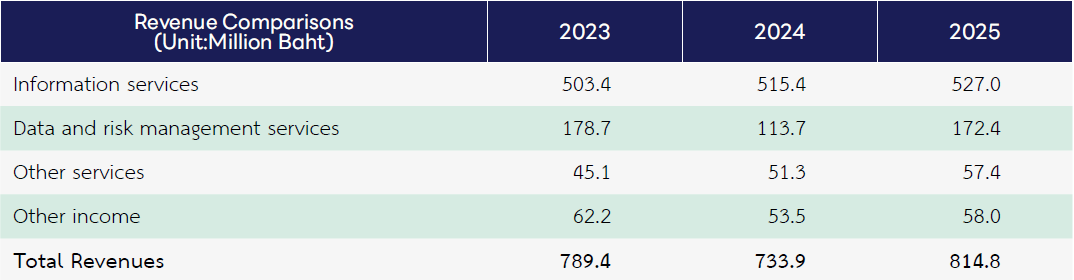
In 2025, the Group presented a total revenues of Baht 814.8 million, decreased by Baht 80.9 million or 11.0% compared with the total revenues in the last year. The main reasons are as following;
A. Information services include providing services through Corpus X, Enlite, Xignal and D&B systems, which are the Group’s organic products. This covers both domestic and international company information. In addition, this is provided as a Decision Support System and in forms of scores and ratings through online and offline channels. The service is provided to private businesses, governmental agencies and other organizations. The revenue from online information is recognized on a straight-line basis over the period of the contract. For the year 2025, information services presented an increase of Baht 11.6 million or 2.2% compared to the previous year. The growth of revenues results from both new and existing customers.
B. Data and risk management services are the service through cooperation with a leading international company to provide risk management tools and also included service of data management. This service income covers both implementation and maintenance services. The Group is recognized the implementation income over time when service have been rendered taking into account the stage of completion and recognized the maintenance services on a straight-line basis over the period of the contract. For the year 2025, data and risk management services presented an increase of Baht 58.7 million from the previous year. The main reason was the commencement of revenue recognition from large-project-based engagements awarded during the year.
C. Other service income is provided to satisfy our customers’ unique requirements and the other projects by using our expertise. For the year 2025, the other service presented an increase of Baht 6.1 million from the previous year.
D. Other income includes interest income, dividend income and other income. For the year 2025, the Group's other income presented an increase of Baht 4.5 million compared to the previous year.
1.1 Comparison of total revenues of the Group by Common-Size method
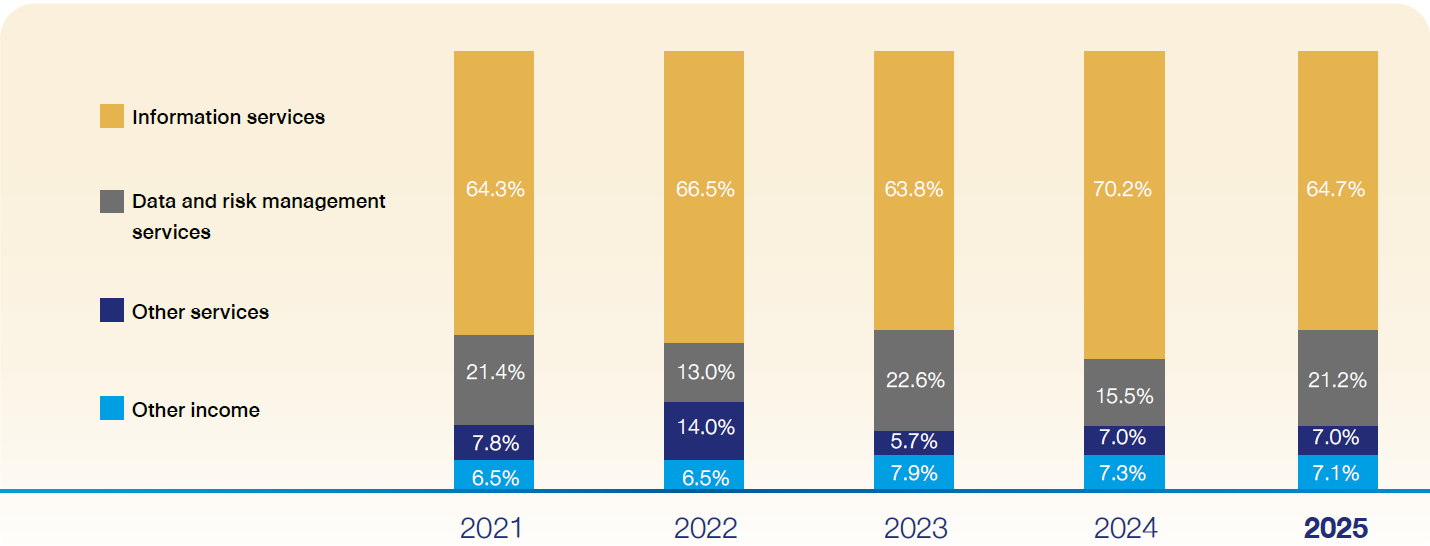
In terms of common size ratio, the Group's total revenues in 2025 presented the increase in revenues from data and risk management services by 5.7%. While, the revenue from information services decreased by 5.5% , respectively. This was mainly due to the recognition of revenue from large projects during the year, which increased the share of project-based revenue in line with project progress. Although the share of information services revenue decreased, revenue from information services still increased in amount, reflecting continued demand for the Company’s data services and solutions.
1.2 Comparison of costs of services and administrative expenses of the Group
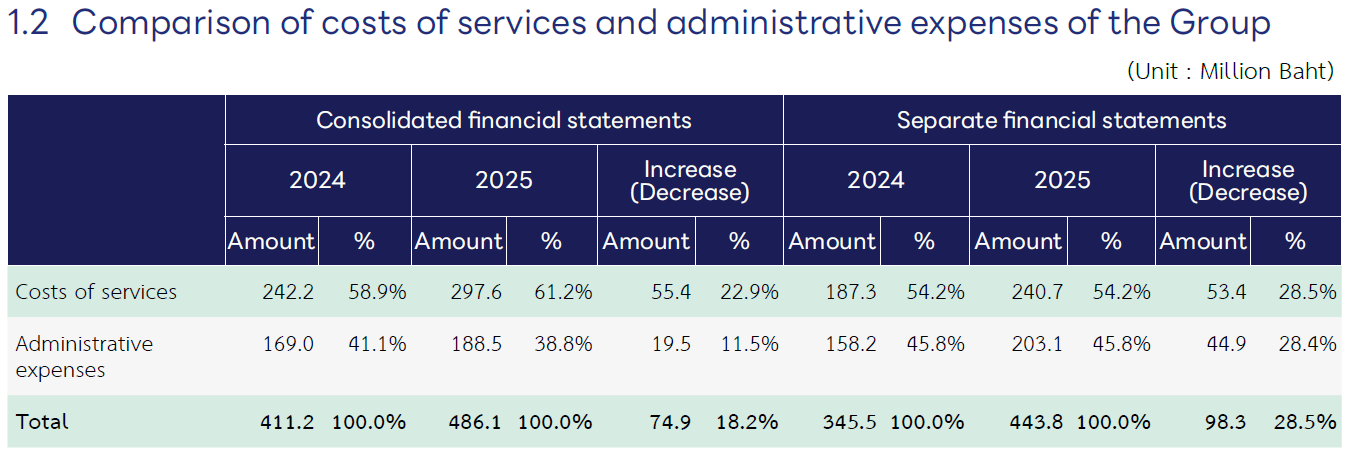
Costs of services and administrative expenses presented an increase by Baht 74.9 million from the previous year. Cost of services increased by Baht 55.4 million. This increase was primarily caused by additional costs and expenses from projects. Administrative expenses also increased by Baht 19.5 million. The primary causes were an increase in personnel expenses and foreign exchange losses.
1.3 Comparison of net profit of the Group
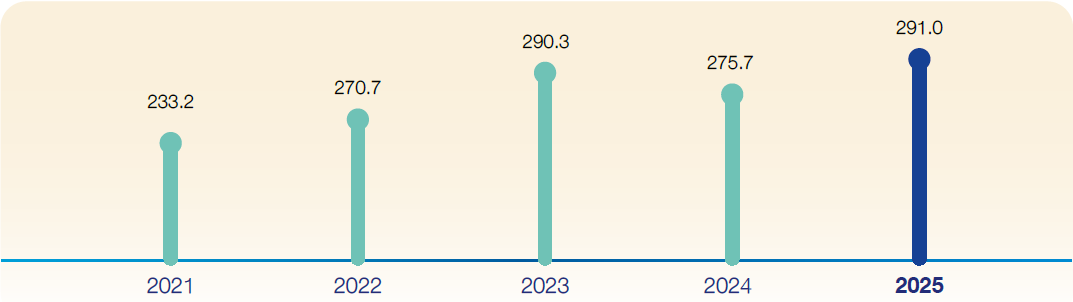
In 2025, the Group had net profit of Baht 291.0 million, which increased of Baht 15.2 million or 5.5% , compared to the consolidated net profit of the last year. The main reason was an increase in data and risk management services (Projects). This was mainly driven by increased revenue recognition from projects during the year, together with growth in information services revenue, resulting in an overall improvement in operating performance.
2. Analysis of Financial Position
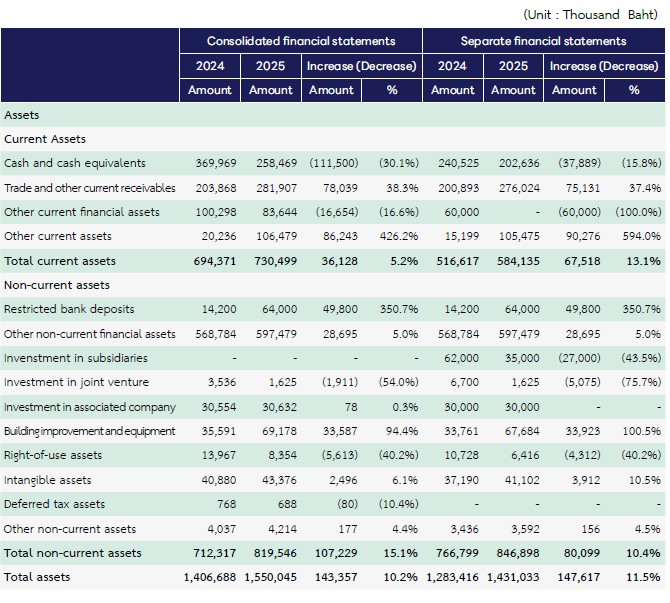
As of 31 December 2025, the Company and its subsidiaries had total assets of Baht 1,550.0 million, representing an increase of Baht 143.3 million, or 10.2% compared to the total assets as of 31 December 2024. The main reasons are as follows:
- Cash and cash equivalents decreased by Baht 111.5 million, mainly due to cash flow used in financing activities,
consisting of the payment of the final dividend for the year 2024 and the interim dividend for the year 2025.
- Trade and other current receivables increased by Baht 78.0 million, mainly due to the increase in
trade receivables and accrued income of Baht 48.8 million and Baht 26.2 million, respectively.
- Other current financial assets decreased by Baht 16.7 million, mainly from the decrease of 6 months
of fixed deposits.
- Other current assets increased by Baht 86.2 million, primarily driven by an increase in deferred costs.
- Restricted bank deposits increased by Baht 49.8 million, mainly from the Company registered fixed deposit
as business collateral.
- Other non-current financial assets increased by Baht 28.7 million, mainly from changes in the fair value
of equity instruments.
- Building improvements and equipment increased by Baht 33.6 million as a result of additions during the year
of Baht 46.7 million, partially offset by depreciation charged for the year of Baht 13.1 million.
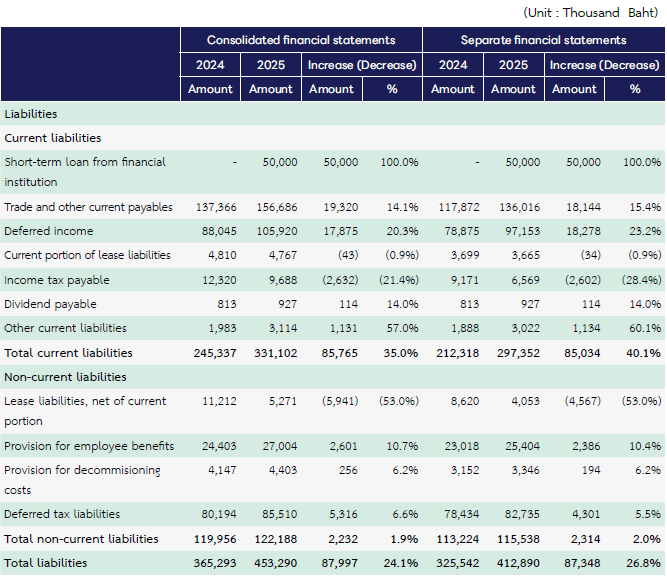
As of 31 December 2025, the Company and its subsidiaries had total liabilities of Baht 453.3 million, representing an increase of Baht 88.0 million, or 24.1% compared to the total liabilities as of 31 December 2024. The main reasons are as follows:
- Short-term loan from financial institution increased by Baht 50.0 million, arising from a promissory note
with a bank to support the Company’s working capital.
- Trade and other current payables increased by Baht 19.3 million, mainly due to an increase in trade payables.
- Deferred income increased by Baht 17.9 million, resulting from an increase in information services income
during the year.
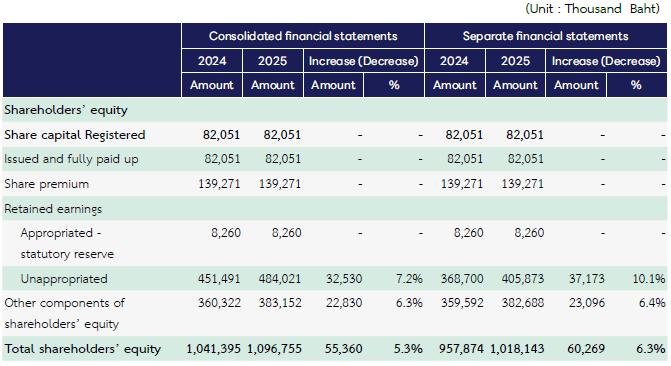
As of 31 December 2025, the Company and its subsidiaries had total shareholders' equity of Baht 1,096.7 million, representing an increase of Baht 55.3 million, or 5.3% compared to the total shareholders' equity as of 31 December 2024. The main reason is as follows:
- Unappropriated retained earnings increased by Baht 32.5 million, mainly due to an increase in the operating
results for the year 2025, which resulted in a net profit of Baht 291.0 million, partially offset by a decrease
in retained earnings from the payment of the final dividend for the year 2024 of Baht 135.4 million and
the interim dividend for the year 2025 of Baht 123.1 million.
- Other components of shareholders’ equity increased by Baht 22.8 million, mainly from gains on changes in
the fair value of equity instruments.
3. Financial Ratio Analysis
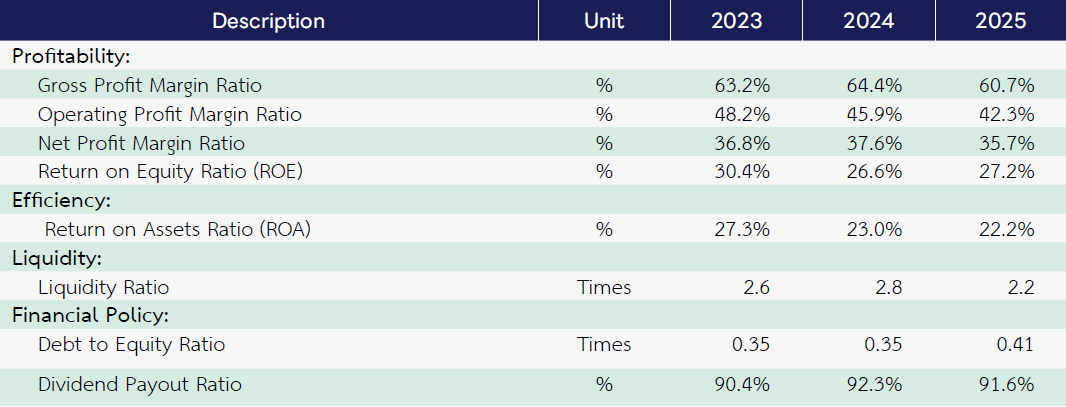
Gross Profit Margin Ratio
In 2025, the Group reported a gross profit margin of 60.7% based on the consolidated statement of comprehensive income, representing a decrease of 5.8% from the previous year. This was mainly due to a higher share of revenue from data and risk management services (project), which carries a lower gross margin than information service revenue. As a result, the overall gross profit margin in 2025 declined compared to the previous year.
Operating Profit Margin Ratio
The operating profit margin in 2025 decreased in line with the gross profit margin, primarily due to the increased share of project-based revenue, which has a higher cost structure than information service revenue. However, the Group continued to manage and control operating expenses appropriately, enabling it to maintain operating profitability at a satisfactory level.
Net Profit Margin Ratio
In 2025, the Group reported a net profit margin of 35.7% based on the consolidated statement of comprehensive income, representing a decrease of 4.9% from the previous year. The decline was mainly due to a higher proportion of service costs to total revenue, in line with costs and expenses associated with project-based revenue. At the same time, income tax expenses in 2025 decreased from the previous year as a result of tax incentives granted under the Board of Investment (BOI) promotion.
Return on Equity Ratio (ROE)
In 2025, the Group’s return on equity (ROE) increased by 2.2% compared to the previous year, mainly due to higher net profit.
Return on Assets Ratio (ROA)
In 2025, the Group’s return on assets (ROA) was 22.2%, representing a decrease of 3.5% from the previous year. The decline was mainly due to the increase in assets at a higher rate than the growth in earnings before interest and tax.
Liquidity Ratio
As of 31 December 2025, the Group’s liquidity ratio was 2.2 times, decreasing from the previous year. This was mainly due to an increase in current liabilities, particularly short-term borrowings from financial institution and higher trade payables compared to the previous year.
Debt to Equity Ratio
In 2025, the Group’s debt to equity ratio was 0.41 times, increasing from the previous year, as total liabilities grew at a higher rate than shareholders’ equity, mainly due to an increase in short-term borrowings to support operations. Dividend Payout Ratio
In 2025, the Group maintained a dividend payout ratio at a level comparable to the previous year, in line with its dividend policy to provide consistent returns to shareholders, taking into consideration operating performance and cash flow.
Liquidity & Capital Adequacy
At the end of 2025, the Group had cash and cash equivalents of Baht 258.5 million, representing a decrease of Baht 111.5 million compared to the previous year. The decrease in net cash compared to the prior year was partly attributable to lower net cash generated from operating activities, mainly due to an increase in trade receivables, as well as an increase in contract work in progress arising from large project-based engagements. During the year, the Group generated net cash from operating activities of Baht 116.5 million, while net cash of Baht 14.1 million was used in investing activities. In addition, net cash of Baht 214.0 million was used in financing activities, primarily for dividend payments to shareholders. In addition, the Group’s liquidity ratio stood at 2.21 times, indicating a healthy liquidity position, as current assets exceeded current liabilities due for settlement. Based on the Group’s cash flow structure and liquidity ratio, the Group has adequate sources of funds to support its operations, sufficient debt servicing capacity, and a high level of financial liquidity.
Asset Management Capability
Trade and Other current receivables
As of 31 December 2024 and 2025, trade and other current receivables of the Group was Baht 203.9 million and Baht 281.9 million, respectively, or equivalent to 14.5%, and 18.2% of total assets, respectively.
Trade receivables
As of 31 December 2024 and 2025, the Group’s trade receivables were Baht 65.3 million and Baht 114.0 million, respectively, representing 4.6% and 7.4% of total assets. The increase in trade receivables at the end of 2025 was in line with higher service revenue during the year, reflecting the expansion of business operations.
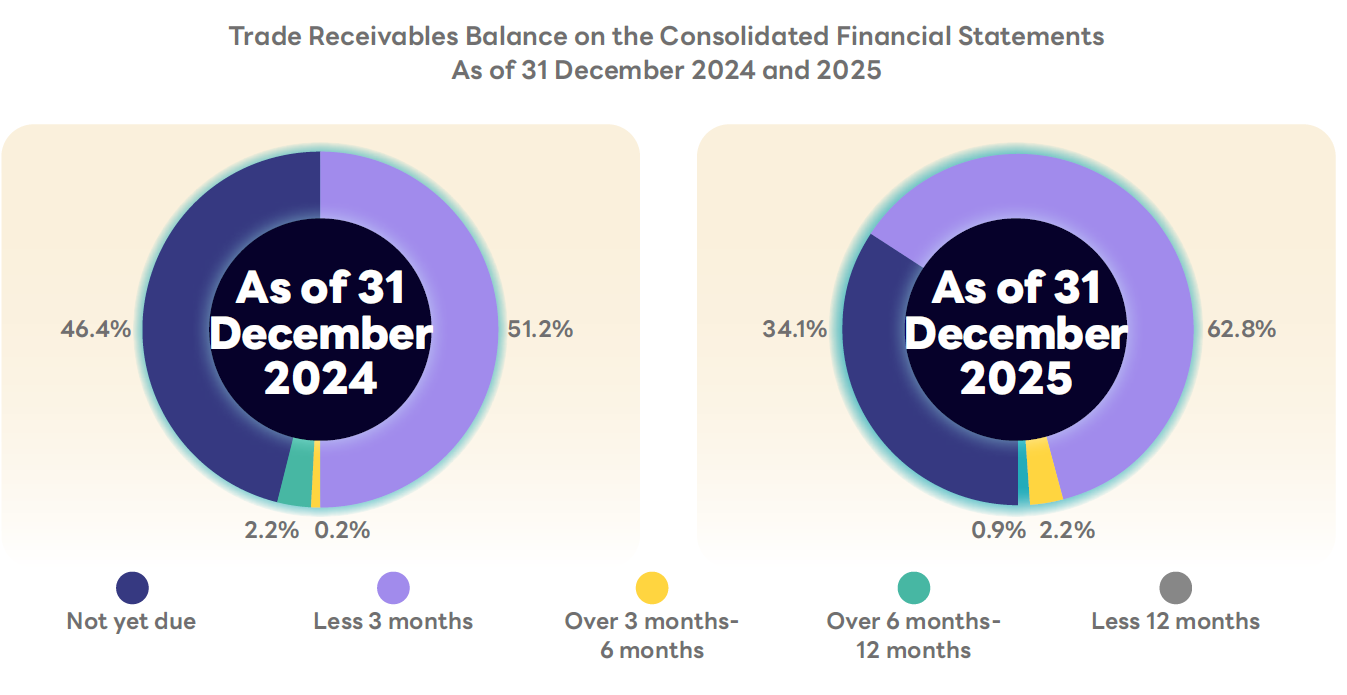
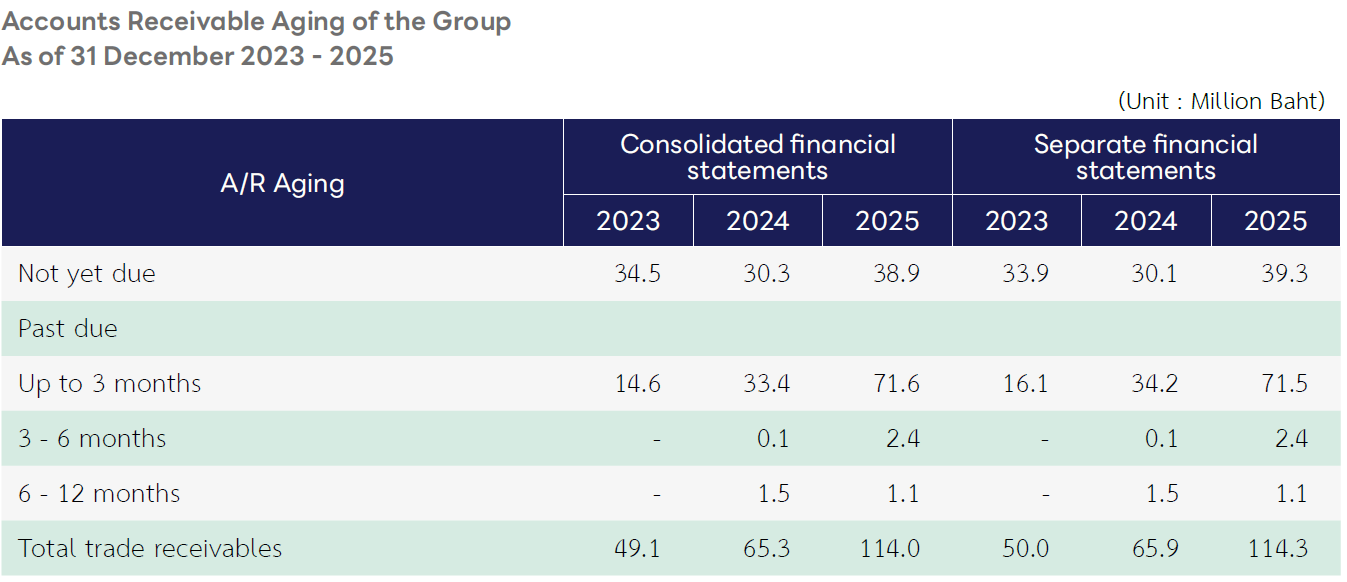
As shown in the table above, the Group has no the allowance for expected credit losses in 2025. For the credit policy of the Group, an average credit term is approximately 30 days. However, the Group may consider the different credit terms for large private enterprises and government agencies from those specified above, depending on the suitability of their business type, qualification and financial status. Furthermore, the Group has a policy to control quality of being the new debtors, including having a credit limit review process and monthly aging account receivables report. In case that the payment becomes overdue, credit department will coordinate with sales and marketing department to analyse the delayed payment problems of each debtor in order to report to the Board of Directors.

In 2025, the Group’s average collection period increased from the previous year, mainly due to a higher proportion of large financial institutions and state-owned enterprise customers, which typically have longer approval and payment cycles exceeding 30 days. As a result, the average collection period increased in line with the customer profile. The Group continues to closely manage credit risk and monitor collections.
Debt Securities with Financial Ratio Requirements
Debt Securities with Financial Ratio Requirements Issued?
No
Factors That May Affect Financial Condition
Factors or Incidents That May Materially Affect Financial Condition
Throughout 2025, the economic and business environment remained subject to uncertainties arising from both domestic and external factors, including changes in policies and regulations related to business operations, volatility in the global economic environment, and rapid technological developments, which may affect the competitive landscape and customer behavior. In addition, the intensity of competition in the data services and digital solutions industry, together with the continuous development of new technologies and the availability of skilled and specialized personnel, may impact the Group’s operational capabilities and future growth.
Nevertheless, the Group has continuously monitored and managed these risks through ongoing system and innovation development, the enhancement of data and information security measures, the development of personnel capabilities, and close monitoring of changes in relevant laws and regulations in order to maintain competitiveness and support sustainable and long-term growth.